
Your Baby Is Home.
Now You Need One Organised Place
to Navigate the First 12 Weeks.
The practical guide that turns scattered advice, endless searching and daily uncertainty into a clear, calm system — designed specifically for Nigerian first-time parents.
GET BABY IS HOME + 2 BONUSES NOW →Secure checkout · Instant digital access · One-time payment · 30-day guarantee
You've waited months for this moment.
And now baby is home — and everything feels like too much at once.
The hospital gave you your baby and sent you home. Your family has arrived with opinions. Your WhatsApp is full of advice. You've bookmarked seventeen articles. You've watched videos. You've asked questions in three different parenting groups.
And yet you still go to bed at night wondering:
"Am I doing this right? What am I forgetting? Who should I actually listen to?"
You're not short of information. You have too much of it — arriving from every direction, often contradicting itself, and leaving you more overwhelmed than before you searched.
You know roughly what needs to happen. Feed the baby. Track the sleep. Change the nappies. Keep appointments. Rest when you can. Ask questions when something worries you.
You know all that. And yet the days still feel chaotic.
Because knowing about something and having a practical system for managing it are two very different things.
If that describes even a part of your current reality, this page is for you.
The chaos of the newborn period costs more than most people talk about.
On the surface, it looks like tiredness. It looks like a rough few weeks that every parent goes through.
But underneath that, the disorganisation of the newborn period quietly costs you in ways that compound:
- Time — spent searching the same questions again and again, trying to remember what you already read, reconstructing the day from scattered phone notes and WhatsApp messages
- Confidence — because when everything feels uncertain and advice conflicts, it's very easy to feel like you're getting it wrong, even when you're not
- Energy — the mental load of having to manage everything from scratch, with no system, while simultaneously recovering and caring for a newborn
- Important details — the question you forgot to ask at the clinic, the feeding pattern you meant to track, the observation you wanted to mention at the appointment
- Relationship harmony — the tension that builds between partners when nobody is clear on who is responsible for what, especially during nighttime
- Peace of mind — because operating on guesswork, even when things are mostly fine, creates a background hum of anxiety that never quite switches off
None of this makes you a bad parent. It makes you a first-time parent navigating something genuinely difficult, without a clear map.
And that's exactly the problem that Baby Is Home was created to solve.
You've already been trying. Here's why it hasn't been enough.
If you're reading this, you've probably already done what most first-time Nigerian parents do. You've searched Google at midnight. You've asked in WhatsApp groups. You've watched YouTube videos. Your mother or mother-in-law has given you her system. Your partner's family has a different one.
You've read articles. You've saved posts. You've downloaded a baby tracking app. You've taken screenshots you can't find anymore.
Here's the honest thing about all of those:
None of them were designed to work together.
A Google search answers one question. A YouTube video demonstrates one technique. A family member shares what worked for them — in different circumstances, often years ago. A parenting forum gives you twenty different opinions. A baby app logs information but doesn't help you understand what to do with it.
You end up as the person who has to collect all of these pieces, evaluate them, filter out the conflicting advice, remember the useful parts, and somehow organise all of it — while caring for a newborn and running on very little sleep.
That's not a failure of effort. It's a missing piece that nobody handed you when you walked out of that hospital.
Here's what may actually be missing — and why it explains so much.
The issue isn't that you don't know enough about newborn care.
The issue is that you have no single, organised system for knowing what to focus on this week, what to track, what to prepare, what to ask a professional, and where to find the right information when you need it.
Think about how you currently operate:
You need to remember how many feeds baby had today. You're trying to recall whether the nappies looked normal. You want to know whether this sleep pattern is typical. You have questions for the next clinic visit — but you'll probably forget half of them when you get there. Your partner is trying to help but you haven't agreed on who handles what overnight. Your in-laws are offering advice that differs from what the hospital said. And you're doing all of this while exhausted.
"Having more information is not the same as having a working system."
What the first 12 weeks actually requires is a practical navigation tool. Not a textbook. Not a course. Not a list of generic tips. A structured guide that tells you what to know, what to do, what to track, and what to ask — week by week, in plain language, designed for the Nigerian first-time parent experience.
That missing piece is what Baby Is Home was built to provide.
Why Baby Is Home exists.
Baby Is Home began with a single honest observation.
First-time Nigerian parents are not short of newborn advice. If anything, they receive too much of it — from hospitals and clinics, from mothers and mothers-in-law, from WhatsApp conversations and Google searches, from social media, from friends who had babies two years ago, and from well-meaning family members who each have a different opinion about the right way to do things.
The problem is not a lack of information. The problem is that when you're tired and adjusting to life with a newborn, having more information — from more sources, arriving all at once — doesn't automatically make the day easier to manage.
What's missing is a practical way to bring the important pieces together.
What to know during each stage of the first 12 weeks. What to do — the daily actions, preparations and routines that create order. What to track — so you're not relying on exhausted memory alone. And what to ask — so that when you sit down with a healthcare professional, you use that time well.
That practical framework — the KNOW → DO → TRACK → ASK system — became the foundation for Baby Is Home.
A guide designed not to overwhelm you with everything you could possibly know about newborns, but to give you a calm, organised navigation tool for the first 12 weeks. One place to return to. One system to follow. Built specifically around the first-time Nigerian parent's real experience.
Please note: Baby Is Home is a practical organisational guide for new parents. It is not a substitute for professional medical advice. Any health concerns about your baby should always be discussed with a qualified healthcare professional.
Imagine waking up and knowing exactly what to focus on today.
Not because everything is figured out. Not because parenthood has somehow become easy. But because you have one organised place to return to — and a simple system for working through it.
You know what this week asks of you. You know what you're tracking and why. You know what questions to bring to the next appointment. You know who handles what overnight. You have a place to write down the observations you don't want to forget.
Your baby is still unpredictable — that's normal. But you feel less scattered. Less reactive. Less like you're managing a crisis and more like you're navigating a season.
That's not a fantasy. That's what a practical, organised system does for the newborn period.
You don't need more advice. You need one calm, well-structured resource that brings everything together.
That's exactly what we built.
Baby Is Home
The First-Time Nigerian Parent's 12-Week Guide to Feeding, Sleep, Bathing, Nappies, Routines and Navigating Life With Your Newborn.
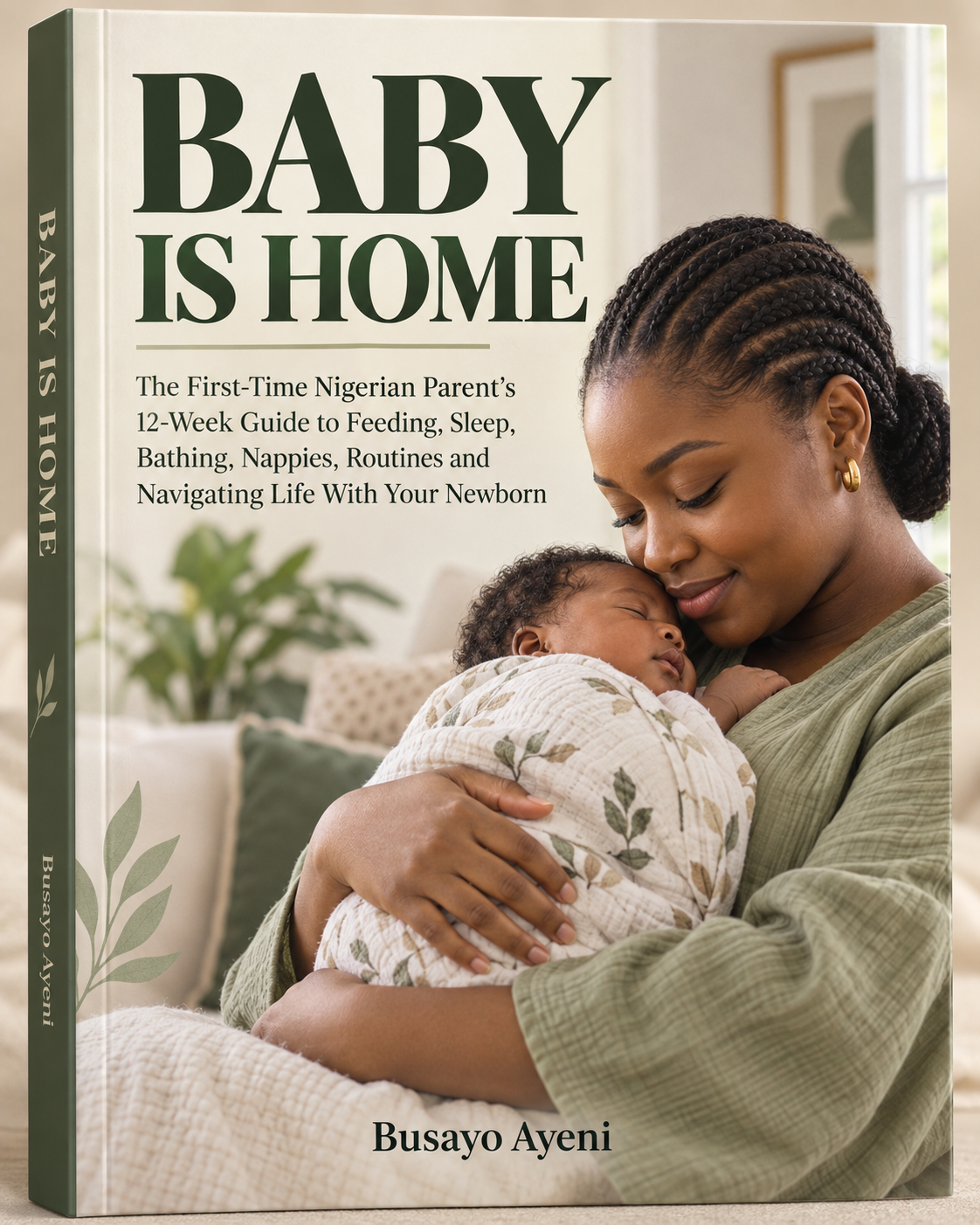
Baby Is Home is a practical, organised digital guide for first-time Nigerian parents navigating the first 12 weeks with a newborn at home.
It is not a textbook. It is not a collection of general parenting tips. It is a structured navigation system built around four simple questions:
What do I need to KNOW this week?
What do I need to DO?
What should I TRACK?
What do I need to ASK?
Every section of the guide is built around those four questions. Every tool, tracker, checklist and weekly dashboard connects back to them.
There are two ways to use it. When you need to understand a specific topic — feeding, sleep, nappies, appointments — go to that chapter. When you simply need to know what to focus on this week, go straight to your week in the 12-Week Navigator.
One guide. Two ways in. Designed to fit around the reality of caring for a newborn — not the other way around.
Secure checkout · Instant digital access · One-time payment
Here's everything inside Baby Is Home.
The guide is built in six parts, designed so a sleep-deprived parent doesn't have to read from cover to cover to get value. Go directly to what you need, when you need it.
The emotional and practical transition from hospital to home — what to expect in the first hours and days, how to use this guide, and what it is and isn't designed to help you with.
A simple, two-page explanation of the framework so you understand how every section connects — and can use the guide as a navigation tool rather than a cover-to-cover read. Includes the quick-reference Start Here page.
Practical feeding organisation that respects different feeding circumstances. Helps you keep useful information together and prepare the right questions for your healthcare professional — without drowning in conflicting advice.
How to understand newborn sleep as an evolving process rather than a fixed routine. Helps you organise nighttime responsibilities between partners and manage expectations without added pressure.
How to track the information that matters — and stop trying to remember everything while exhausted. A simple nappy tracker you'll actually use.
Practical organisation around daily care routines, with clear guidance on when professional advice is needed and when everyday management is enough.
A calm framework for the unsettled moments — including a "What Have We Checked?" prompt sheet that helps you think clearly when baby is crying and your brain doesn't want to cooperate.
Instead of a rigid routine you'll abandon by day three, this helps you build a practical household rhythm — covering nighttime responsibilities, feeding preparation, rest, laundry, visitors and partner communication.
One of the most Nigerian-specific sections in the guide. How to appreciate family support while remaining clear about your own decisions — including how to handle conflicting advice respectfully, communicate boundaries without confrontation, and navigate the Omugwo period with less friction.
How to arrive at every clinic visit prepared — with the right questions written down, observations organised, and nothing important forgotten. Includes an appointment preparation sheet, questions page, important contacts sheet and appointment notes.
A clear, honest chapter that helps you know when something belongs with a qualified healthcare professional — and how to get appropriate help without either panicking or dismissing real concerns.
The heart of the guide. Each week has its own one-to-two-page dashboard covering exactly what to KNOW, DO, TRACK and ASK during that specific week — from "We're Home. Now What?" in Week 1 through to "Look How Far You've Come" in Week 12. No need to read the entire guide. Go to your week. Start there.
Pages designed to be returned to without rereading whole chapters. Includes: important baby information sheet, important contacts, appointment planner, questions-for-the-clinic page, feeding notes, sleep notes, nappy notes, daily observations, parent responsibility planner, visitor/support planner, weekly reflection, and a "Things I Want To Ask" page.
And here's what comes with it — at no extra cost.
When you get Baby Is Home today, you also receive two companion resources that complete the system.
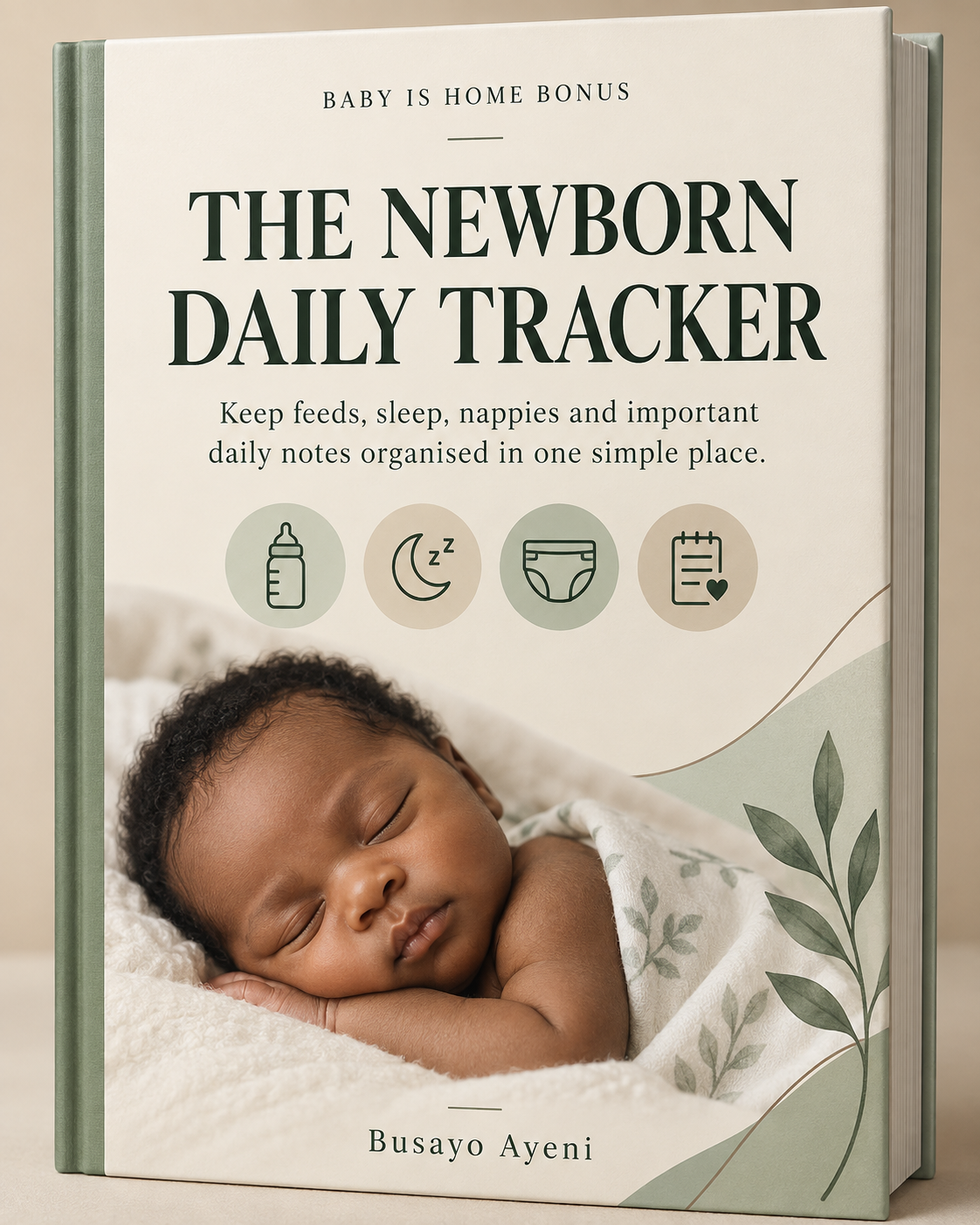
The Newborn Daily Tracker
Keep feeds, sleep, nappies and important daily notes organised in one simple place.
Every new parent tells themselves: "I'll remember." Then sleep deprivation happens. Instead of trying to reconstruct the day from scattered phone notes, WhatsApp messages and half-remembered conversations, this tracker gives you one consistent place for the everyday information that matters. Simple. Printable. Reusable.
This directly strengthens the TRACK layer of the main guide system.
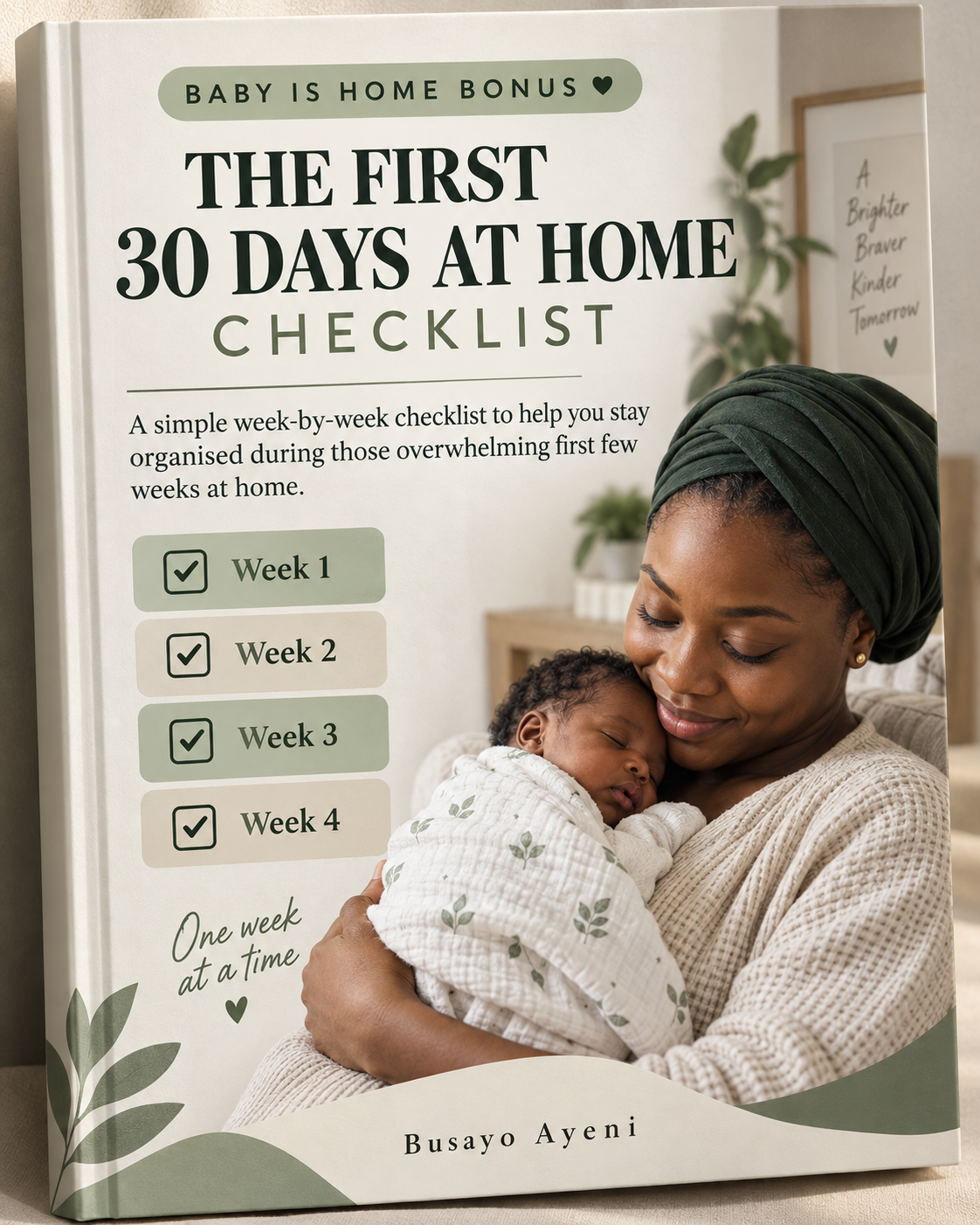
The First 30 Days At Home Checklist
A simple week-by-week checklist to help you stay organised during those overwhelming first few weeks at home.
The main guide covers 12 weeks. But the first month is often the most intense — and the most likely to feel completely unmanageable. This checklist strips that first month down into a simple, week-by-week list. Don't think about everything at once. Here's what to focus on this week. Check it off. Move forward.
This directly strengthens the DO layer of the main guide system.
The three resources together form a complete newborn navigation system: NAVIGATE with the main guide. TRACK daily information with Bonus 1. DO the practical steps with Bonus 2.
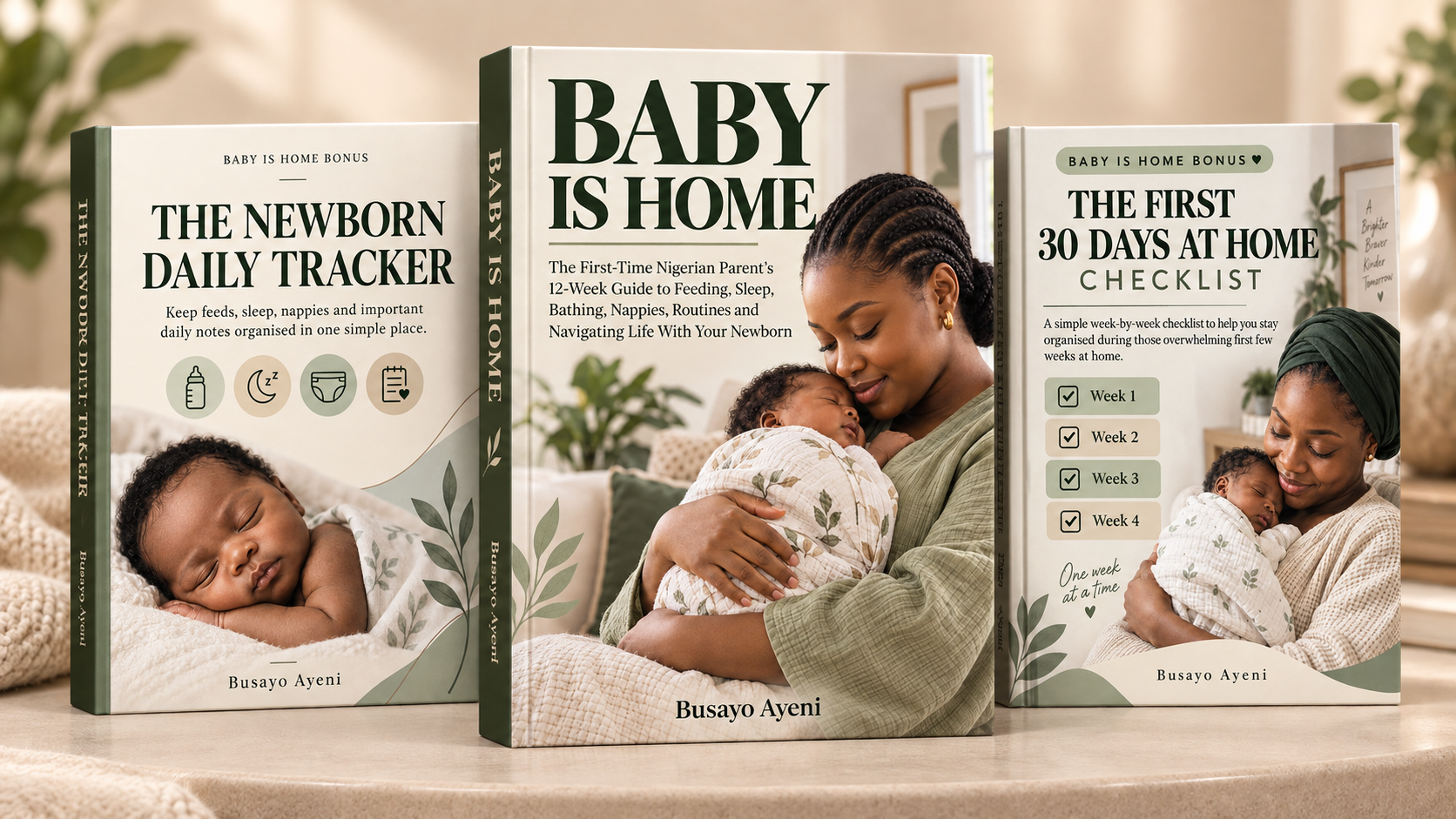
Everything You Receive Today
✦ Baby Is Home — The 12-Week Newborn Navigator
✦ Bonus #1: The Newborn Daily Tracker
✦ Bonus #2: The First 30 Days At Home Checklist
Planned regular price: ₦21,500
Introductory Launch Price — first 29 buyers only₦9,350
One-time payment. No subscription. Instant access.
GET BABY IS HOME + 2 BONUSES NOW →Secure checkout · Instant digital access · 30-day money-back guarantee
30-Day Money-Back Guarantee
Try Baby Is Home for a full 30 days. Read through the guide. Use the trackers. Work through your first weeks with the Navigator. If you decide it isn't useful for you, simply contact us within 30 days of purchase with your name, email address and order reference — and you'll receive a full refund. No complicated process. No awkward questions.
You either find it genuinely helpful, or you don't pay for it. That's the arrangement.
This introductory price is for the first 29 buyers only.
Baby Is Home is launching at ₦9,350 as an introductory price for the first 29 customers. Once those 29 introductory spots are taken, the price moves to the planned regular price of ₦21,500.
There's no countdown timer on this page. But the introductory pricing is genuine — and it will end when the 29th sale completes.
GET INSTANT ACCESS →Questions you might be sitting with right now.
Yes — that's exactly why the guide is built as a navigation system rather than a rigid rulebook. Baby Is Home doesn't tell you there is one correct way to feed, settle or organise your household. It gives you a framework for organising your decisions, your information, and your approach to the first 12 weeks. It adapts to you, not the other way around.
Because Baby Is Home isn't another stream of information. It's a system for organising the information you're already receiving. The difference is integration — one place to return to, one framework to work within, one set of tools designed to work together. That's what the individual Google searches and WhatsApp groups and parenting apps can't give you on their own.
Free information online is exactly the problem this guide solves. You're already swimming in free information. What you're paying for isn't the information itself — it's the organisation, the structure, the practical tools, and the week-by-week navigation system that brings everything together in one place and tells you what to focus on right now. That's what ₦9,350 buys you. Hours of searching, collating and second-guessing — replaced with one practical guide.
It was specifically designed for that reality. The weekly dashboards are one to two pages each. The toolkit pages are standalone — you don't have to reread chapters to use them. The guide has two entry points: go to a topic chapter when you need to understand something, or go directly to your week in the Navigator when you just need direction. You don't have to read it cover to cover. You're meant to dip in and out, as your days allow.
Immediately after payment. Baby Is Home is a digital guide delivered instantly to your email. You can be reading Week 1 within minutes of completing your purchase — on your phone, tablet or laptop.
It was built specifically around the Nigerian first-time parent experience. That includes the Omugwo section, the family-advice and visitor management tools, the way conflicting guidance is addressed, and the overall tone — which understands that Nigerian parents receive newborn advice from many directions simultaneously. This is not a Western parenting guide with the word "Nigeria" added to the title.
Two ways this plays out from here.
You close this page and carry on as you have been. Searching Google at 2am. Gathering advice from three different WhatsApp groups. Trying to remember how many feeds baby had today. Wondering what to ask at the clinic. Managing everything from scattered notes and exhausted memory.
It isn't failing. Millions of parents navigate the newborn period exactly this way. But it's harder than it needs to be — and you already know that, or you wouldn't be reading this.
Or you try a different approach.
Without a system
Still searching for answers every few days. Still receiving conflicting advice with no framework for organising it. Still trying to reconstruct the day from memory. Still forgetting what to ask at appointments. Still uncertain whether you're managing the right things.
Surviving — but more scattered than you need to be.
With Baby Is Home
One guide. One system. One place to return to.
You know what to focus on this week. Your tracking is together in one place. Your appointment questions are written down. Your household responsibilities are agreed. You have tools for the hard moments.
Still figuring things out — but with a map in your hand.
I won't promise this makes parenthood easy. It doesn't. But it can make the first 12 weeks significantly less chaotic — and that is a reasonable, honest thing to invest ₦9,350 in.

Busayo Ayeni
Creator, Baby Is Home
Baby Is Home was created with a clear purpose: to give first-time Nigerian parents one practical, organised place to navigate the newborn period — rather than leaving them to piece together scattered information on their own.
The newborn-care content in this guide is written with appropriate professional boundaries in mind. It is a practical organisation resource, not a substitute for qualified medical advice.
Ready to navigate the first 12 weeks with a clear system?
Here's everything you receive today, for one introductory payment of ₦9,350:
✦ Baby Is Home — The 12-Week Newborn Navigator
✦ Bonus #1: The Newborn Daily Tracker
✦ Bonus #2: The First 30 Days At Home Checklist
✦ 30-Day Money-Back Guarantee
Secure checkout · Instant access · One-time payment · 30-day guarantee
P.S. — The newborn period is genuinely hard. But a significant part of what makes it hard is the disorganisation — the scattered searching, the conflicting advice, the trying to remember everything while running on almost no sleep. Baby Is Home gives you a practical system for that part. Not all of parenthood. Just the part where having a map actually helps.
P.P.S. — The introductory price of ₦9,350 is available for the first 29 buyers only. Once those spots are taken, the price increases to ₦21,500. If you're reading this and that offer is still available, now is the right time. And if the guide doesn't work for you, you have 30 days to ask for your money back.
P.P.P.S. — Your baby is home. This season will pass quickly, even when the days feel endless. The things you put in place now — the systems, the organisation, the habits — make the difference between surviving and navigating. You deserve a little help finding your feet. That's exactly what this guide is for.