Payment Successful.
The door is about to open. Not because you'll force it. Because you'll learn to knock differently.
Shouting escalated the fights. Grounding taught secrecy, not respect. Being his friend stripped your authority. Laying down the law killed the connection. Every strategy you tried treated his development as a problem to fix. It was never a problem. It was a transition to navigate. You just chose the method that teaches you HOW to navigate it so the battles end, the trust rebuilds, and the door that's been slamming for months finally stays open.
21 days. You change first. He follows. The door opens because he chooses to.
🚪 "My child is not the exception. My child is developing. Adolescence is separation, not defiance. When I stop fighting the separation and start supporting it, the fighting stops. The door opens. Not because I demanded it. Because my teenager sees that disagreement doesn't mean rejection and growing up doesn't mean growing apart. I change my approach. He changes his response. 21 days."
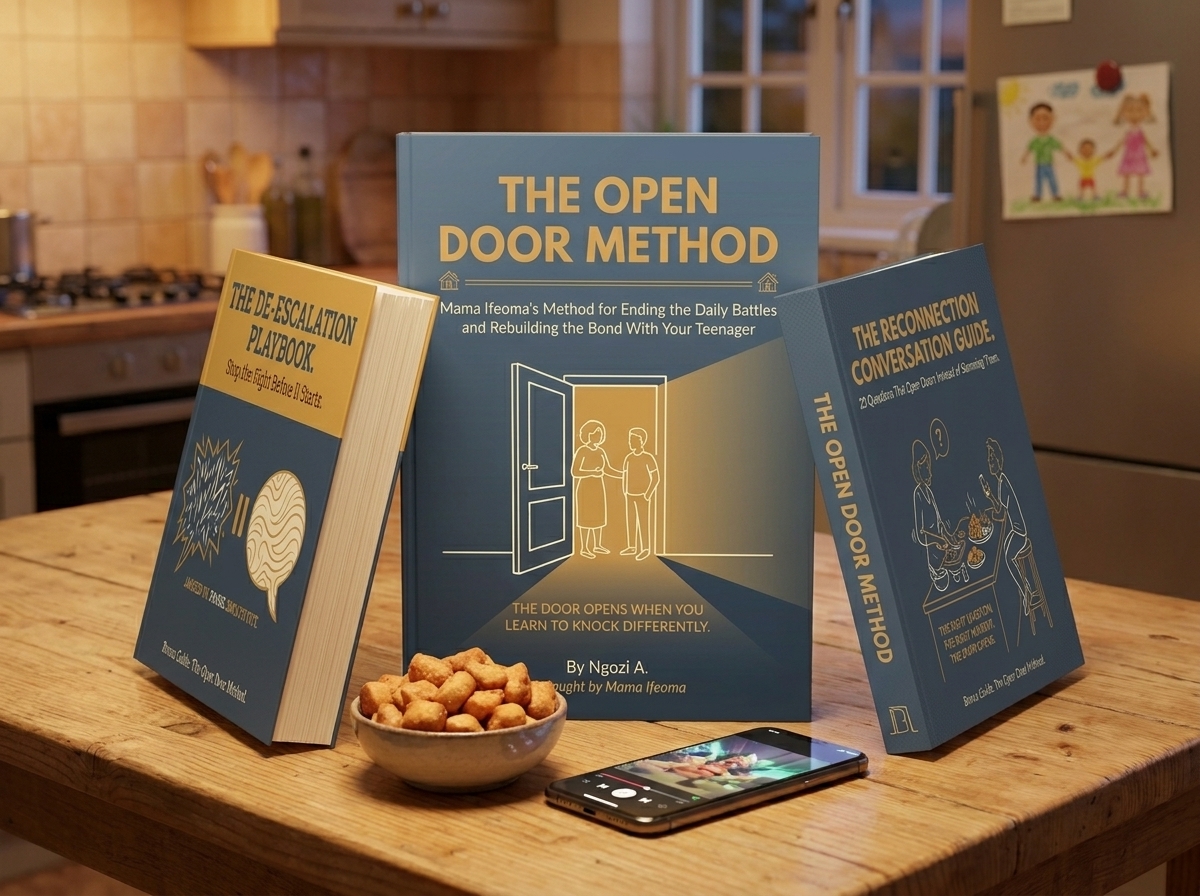
Your Complete System Is Ready
Click the button below to download the full method and both bonus guides instantly.
Download Your Guides Now🚪 Here's What You Got
Mama Ifeoma's complete 3-part system: the Understanding Framework (what's actually happening in your teenager's brain), the Communication Reset (4 patterns that escalate replaced by 4 that connect), and the 21-Day Reconnection Protocol (day-by-day trust rebuilding)
How to stop fights before they start. The 5-second pause. The tone drop. The strategic withdrawal. 10 real scenarios with exact scripts: homework battles, phone wars, curfew negotiations, disrespectful language
20 conversation starters that open doors instead of slamming them. The questions that replace "how was school." The car conversation technique. The kitchen orbit method. Exact phrases for the first 21 days
Your First 48 Hours
Download Everything Now
Tap the button above. Save all 3 files to your phone. You'll reference these guides daily for the next 21 days.
Read the De-Escalation Playbook Tonight (Bonus #1)
Start here FIRST. The next fight is coming. It might be tonight. It might be tomorrow morning. Open Bonus #1 and learn the 5-second pause technique and the tone drop. These two tools alone can de-escalate a fight within the first 48 hours. You don't need the full method yet. You need to stop the next battle from becoming a war. The Playbook gives you that power immediately.
Read the Understanding Framework (Part 1 of Main Method)
Tomorrow morning, read Part 1. This is the foundation. It explains what is actually happening in your teenager's brain: why they fight, why they withdraw, why they say things that feel like hatred. When you understand the WHY, your emotional response changes from "he's attacking me" to "he's developing." That shift changes everything that follows.
Start the Communication Reset (Part 2)
Part 2 gives you the new patterns. The 4 escalators to STOP (shouting, demanding, interrogating, lecturing) and the 4 connectors to START (validating, inquiring, timing, listening). Begin replacing ONE escalator with ONE connector. Not all four at once. One. The method builds gradually because your teenager will notice sudden change and distrust it.
Read the Conversation Guide (Bonus #2)
Open the 20 conversation starters. Pick ONE for tomorrow. Not "how was school" (which always gets "fine"). Try: "What annoyed you most today?" or "What's the funniest thing that happened this week?" The RIGHT question at the RIGHT moment opens more doors than any punishment ever closed.
Begin the 21-Day Protocol on Day 3
By Day 3, you'll have the Understanding Framework, the first Communication Reset patterns, and the De-Escalation Playbook active. Now start the day-by-day Reconnection Protocol. Small daily actions. Not dramatic gestures. A text that says nothing important. A snack left outside his door without knocking. A question with no follow-up. The protocol rebuilds trust through consistency, not intensity.
🚪 What to Expect Over 21 Days
⚡ Do This Right Now
Open the De-Escalation Playbook (Bonus #1) to Page 3: "The 5-Second Pause."
This is the single most powerful de-escalation tool in the entire system. When your teenager says something that triggers your anger reflex, PAUSE for 5 seconds before responding. Not to count. To breathe. To let the reactive response pass through you without exiting your mouth. In 5 seconds, the shout you were about to deliver transforms into a sentence. And a sentence, delivered calmly, lands harder than any shout ever could.
The next confrontation is coming. It could be tonight. When it arrives, try 5 seconds of silence before your first word. His expression will change. Because the person he expected to shout just... didn't.
"Your child is not the exception. Your child is developing. And you were never taught how to parent development. This method teaches you."

A message from Ngozi:
Mama, I know the door. I heard it slam every day for 2 years. My son told me he wished he didn't live here. I managed 30 people at work and couldn't manage the one person I loved most. I tried everything: shouting, grounding, being his friend, laying down the law. Each strategy made the door slam harder.
Then Mama Ifeoma showed me what none of those strategies understood: my son wasn't defying me. He was SEPARATING from me. And separation is not rebellion. It's biology. Every mammal separates during adolescence. The arguments are his developing brain practising independence on the safest person he knows. Me.
When I stopped fighting the separation, he stopped making it violent. By Day 10, the door was ajar. By Day 17, he sat in the kitchen and showed me a video. "Mummy, look at this." By Day 21, he knocked on MY door, sat on my bed, and said: "I know I've been difficult."
Start with the De-Escalation Playbook tonight. The 5-second pause alone will change the next fight. Then the Understanding Framework tomorrow. And when Day 5 arrives and the door still slams, hear my voice: You changed for 5 days. He's experienced 2 years of the old pattern. His defences need time to disarm. Day 10 is where he notices. Day 14 is where he tests. Day 21 is where the door opens. Hold the new pattern. He'll come.
Your child is still in there. Behind the slammed door. Waiting to see if it's safe to open it. 21 days of knocking differently. The door opens. 🚪
Ngozi
🚪 21-Day Conditional Guarantee
Follow the method for 21 days. If you don't notice a meaningful shift in how your teenager responds to you and how your home feels, full refund. You keep everything regardless.
Need Help?
Questions about the framework, the conversation starters, the de-escalation techniques, or anything at all? Mother to mother. We understand.
The Open Door Method © 2026. All Rights Reserved.
Disclaimer: This guide provides parenting strategies and communication techniques for navigating adolescent development. It is not a substitute for professional family counselling, therapy, or mental health support. If your teenager is expressing thoughts of self-harm, engaging in dangerous behaviour, or showing signs of mental health crisis, seek professional help immediately. Individual family dynamics vary. Results depend on consistent application and individual circumstances.