Nkechi's Parenting Journal | Real Solutions for Caring Mothers Everywhere
Mother of 3 Discovers a Simple 14-Day Method That Stopped Her 8-Year-Old Son's Bedwetting Completely — After 3 Years of Midnight Wake-Ups and Wet Sheets Did Nothing
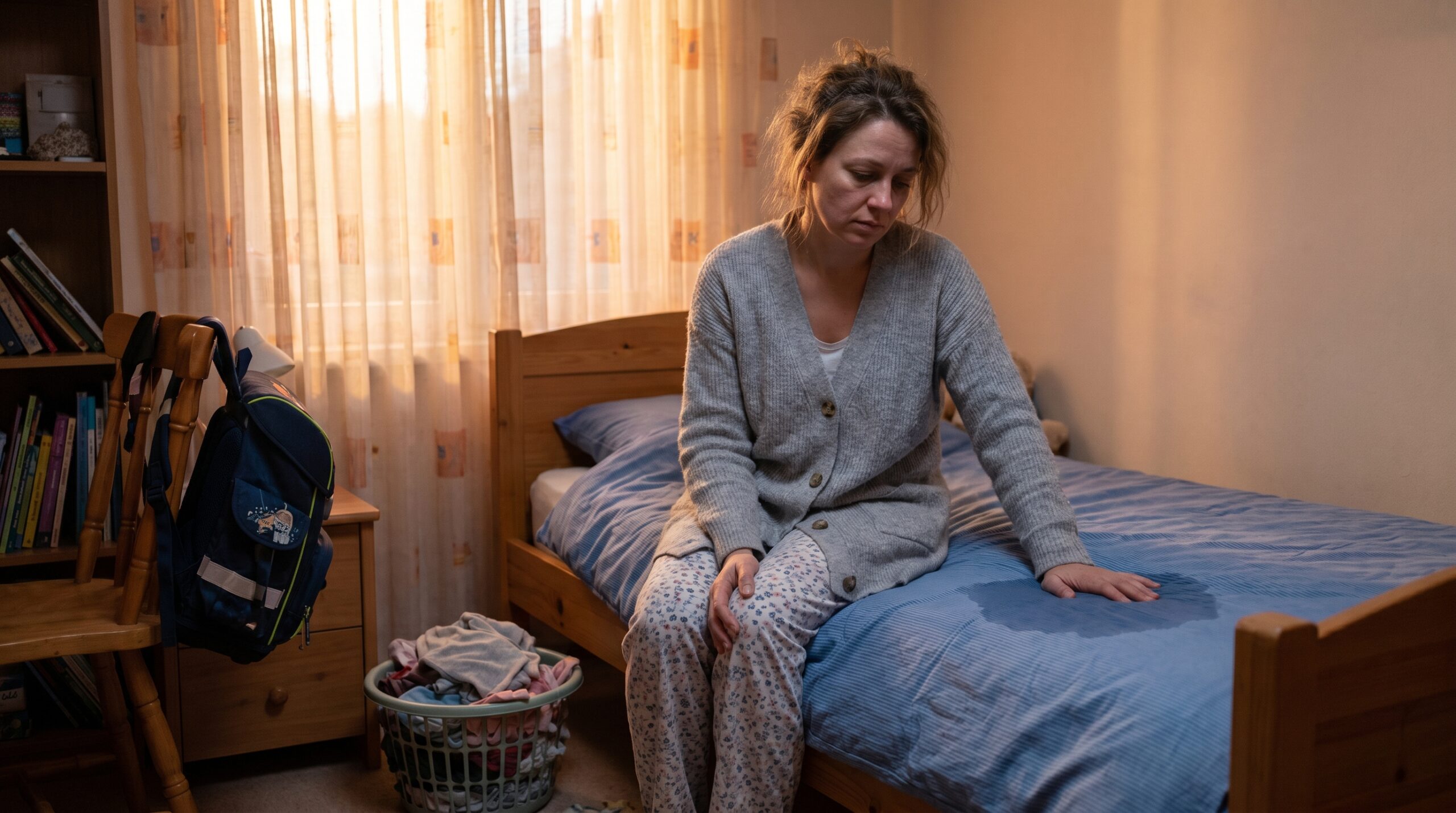
You already know what tonight will bring.
You'll tuck them in. Kiss their forehead. Say "goodnight, sleep well."
And sometime around 2am or 3am… you'll smell it. Or feel the dampness when you reach across to check the sheet.
Again.
The same wet mattress. The same pile of sheets to wash before anyone else wakes up. The same quiet, exhausted routine you have been living for months — maybe years.
You have tried everything people told you to try:
— You stopped giving water after 6pm.
— You wake them up at midnight to use the bathroom. Sometimes twice.
— You tried the bedwetting alarm. (It didn't wake your child — it woke YOU.)
— You put a waterproof cover on the mattress.
— You even tried those pull-up pants — and watched your child's face fall putting them on.
Nothing works. The bed is still wet every morning.
And the worst part is not the laundry.
It is the other things. The things that keep you awake long after the sheets are changed and the lights are off.
Like the fact that your child cannot sleep at their friend's house or grandma's — because you are terrified it will happen there and they will never live it down.
The school trip you had to say no to — because what if it happens on the overnight bus or in the cabin?
The sleepaway camp conversation you keep putting off — because you know they are not ready and your heart breaks every time the brochure comes in the mail.
The birthday sleepover they were invited to last month. The excuse you made. The look on their face when you said they couldn't go. That look stays with you.
And then there are the people around you.
Your mom: "At his age? Honey, have you talked to the pediatrician about this?"
Your friend: "Have you tried cutting fluids earlier? Maybe he is just a really deep sleeper."
Your partner: "He will grow out of it. Kids do. Can we not stress about this tonight?"
Nobody truly understands what this feels like from inside your house. From inside your 2am. From inside the guilt and the exhaustion and the quiet heartbreak of watching your child carry something this heavy.
Your child is not lazy. They are not doing this on purpose. They do not even know it is happening — they are asleep.
But they are starting to feel ashamed. You can see it. The way they check their own bed the moment they open their eyes. The way they go very quiet when other kids at school talk about sleepovers and summer camp.
And you — you are exhausted in a way that sleep does not fix. Because the exhaustion is not just physical. It is the weight of carrying this alone. Of protecting the secret. Of wondering when — or if — this will ever end.
If this is your life right now, please keep reading.
Because what I am about to share ended this nightmare for my family — in 14 days.

My full name is Nkechi Emily Douglas. But everyone who knows me calls me Nkechi.
It is the name my husband — James — gave me the day we got engaged. He said Emily was beautiful, but Nkechi was the name that sounded like the woman he had fallen in love with. I laughed at him. He was always like that. Finding the poetry in ordinary things.
James passed away four years ago. Suddenly. The kind of loss that reorganises everything — every priority, every plan, every morning.
And in the months after he was gone, I was raising three boys alone, working full-time, and dealing with something I had been quietly managing for 2 years already:
My middle son Brian — 8 years old — was still wetting the bed every single night.
I want you to understand what that period looked like. A grieving widow. Three young boys. A job that needed showing up to. And a child who was waking me at 2am — not because he needed me — but because I had trained myself to check before he even stirred.
I'm not a doctor. I'm not a nurse. I'm not a child psychologist.
I am a mother who had been carrying this quietly for years. And after James died, I was carrying it alone.
Brian's bedwetting started when he was about 5. I told myself it was normal. "He will grow out of it."
He turned 6. Still wetting.
He turned 7. Still wetting.
By 8, I was genuinely scared it was never going to stop.
I took him to the pediatrician. She checked him over, said there was nothing physically wrong, and told me: "Some children are just deep sleepers. He will likely outgrow it. Be patient."
Patient.
I had been patient for 3 years. I was washing sheets every day. Setting my alarm for 1am, sometimes 3am. Carrying a sleeping child to the bathroom in the dark and he would not even remember it in the morning.
I was also grieving. I was also exhausted. And the doctor's advice was essentially: wait and hope.
So I went online. I joined parenting forums. I read everything I could find on childhood bedwetting. And I tried everything:
— Cutting fluids after 5pm (Brian was thirsty and miserable and still wet the bed)
— Reward charts for dry nights (he tried so hard — and the empty chart just made him feel worse)
— Waking him at midnight and again at 3am (I was a zombie at work and nothing changed)
— A bedwetting alarm I ordered online ($80 I will never get back — he slept straight through every alert, it woke his brothers instead)
— Pull-up pants — he cried putting them on and begged me not to tell his friends
Nothing worked. And my son was starting to break.
He stopped wanting to go to his friend Jake's house for playdates. He cried the week his class organised a camping sleepover and all his friends were going. He looked up at me one evening and said:
"Mom. Is something wrong with me? Like, actually wrong with me?"
That question destroyed me.
My 8-year-old son — who had already lost his dad — was sitting on the edge of his bed asking me if something was medically wrong with him because of something he had zero control over.
I held him for a long time. And I told him no. And I went to the bathroom so he would not see me fall apart.
Then, something happened that changed everything.
A colleague of mine — Sarah — noticed I was dragging myself through Monday mornings more than usual. She asked how I was holding up. I finally told her everything.
She listened. Then she said quietly:
"My daughter had the same thing until she was 9. I tried everything you are describing. Our pediatrician said the same — just wait. But I found a method through a child development specialist that explained exactly why all those common approaches fail. The issue is not how much they drink or how deeply they sleep. It is a specific brain-bladder signal that has not fully matured yet — and there are simple, natural ways to train it. My daughter was dry in 16 days."
I grabbed her arm across the desk and said: "Tell me everything. Right now."
What she shared with me over the next 30 minutes changed Brian's life. And mine.
Sarah explained something no pediatrician, no parenting book, and no parenting forum had ever told me clearly:
Bedwetting in children over 5 is not a behavioural problem. It is a developmental delay in one specific body function — the "bladder-brain signal" that tells the brain to wake up and hold urine when the bladder is full during sleep.
In most children, this signal matures automatically by age 4–5. But in about 15–20% of children worldwide, it develops more slowly. That is it. Not laziness. Not deep sleep. Not too much water before bed. A signal that simply has not fully connected yet.
And here is what nobody tells you:
Most of the common approaches — limiting fluids, midnight wake-ups, punishment — actually make bedwetting WORSE.
Limiting fluids dehydrates your child and makes their urine more concentrated — which irritates the bladder and can cause MORE frequent wetting.
Waking them at midnight trains YOU to be their alarm clock — but does absolutely nothing to train THEIR brain to recognise the signal on its own.
Punishment and shame trigger anxiety — and anxiety is clinically linked to increased bedwetting episodes. Every time you show frustration, you are making the problem harder to solve.
You have been fighting this with the wrong tools. Not because you are a bad mother. Because nobody gave you the right ones.
The method Sarah described focused on three things:
— Bladder training exercises during the day — simple, 5 minutes, feels like a game to your child
— A specific evening routine that prepares the brain-bladder connection for sleep
— A confidence-building progress system that rewards effort and progress — not just dry nights — so your child's self-esteem grows instead of crumbles
No drugs. No alarms. No fluid restriction. No midnight torture.
Just a structured, natural system that helps your child's body complete the developmental process it was already trying to do on its own.
I started with Brian the very next morning.
I still get emotional talking about what happened next.
Days 1–3: We started the bladder training exercises. Brian thought it was a game. He was so excited to have a "mission" — something to do instead of just feeling broken and ashamed. He still wet the bed every night. But I had been told to expect that and not to panic.
Days 4–6: We added the evening routine. Simple steps — timed bathroom visits, a specific breathing technique before bed, no screens in the last 30 minutes. On Day 5, something extraordinary happened. Brian woke up at 4am — on his own — walked himself to the bathroom, and came back to bed. He had never done that before in 3 years. The sheet was dry that morning.
I did not make a big deal of it. The guide said to mark it quietly on the progress chart and carry on.
Days 7–10: He wet the bed twice. But the other nights? Dry. Four dry nights in a row at one point. I had not seen four consecutive dry nights in three years. When he checked his bed on the fourth dry morning and realised — the look on his face was something I will carry with me for the rest of my life.
I went to the bathroom so he would not see me crying. I sat on the edge of the tub and thought of James. I wished he could have seen it.
Days 11–14: Every single night — dry. Seven consecutive dry nights. Brian started checking his bed every morning with this little smirk, like he already knew what he would find before he even looked.
On Day 14, he came into the kitchen at breakfast and said:
"Mom. I think I fixed it."
I pulled him in and held him so tightly. He did not understand why I was crying. I did not try to explain.
That was 5 months ago. Brian has wet the bed exactly twice since then — both times when he was running a fever. Every other night: dry.
He went to stay at his grandparents' house for a week last summer. First time he had slept away from home in over 2 years. He came back glowing.
His class signed up for the school camping trip last month. For the first time — without hesitation — I said yes.
We are even talking about sleepaway camp next summer. Something I could not have imagined saying six months ago.
My son has his childhood back. And I — for the first time since James died — feel like I am breathing properly again.
I shared the method with my friend Claire, whose 10-year-old daughter had been wetting the bed for years. Consistent dry nights by Day 11.
Then another mother from the school gate tried it. Then women from an online parenting support group. Then parents from different countries who found me through social media.
Over the past few months, more than 150 families across the world have used this method — and the results are remarkably consistent. Most children see their first dry night between Day 4 and Day 7. By Day 14, the majority are sleeping dry every night.
Not every child is identical. Some take 10 days. Some take 21. But the method works because it addresses the ROOT cause — not just the symptom.
Eventually, I could not keep responding to messages one by one. So I put everything — the full 14-day system, the bladder exercises, the evening routine, the progress tracker, the parent's guide, and two bonus resources — into one simple downloadable guide.
Introducing…
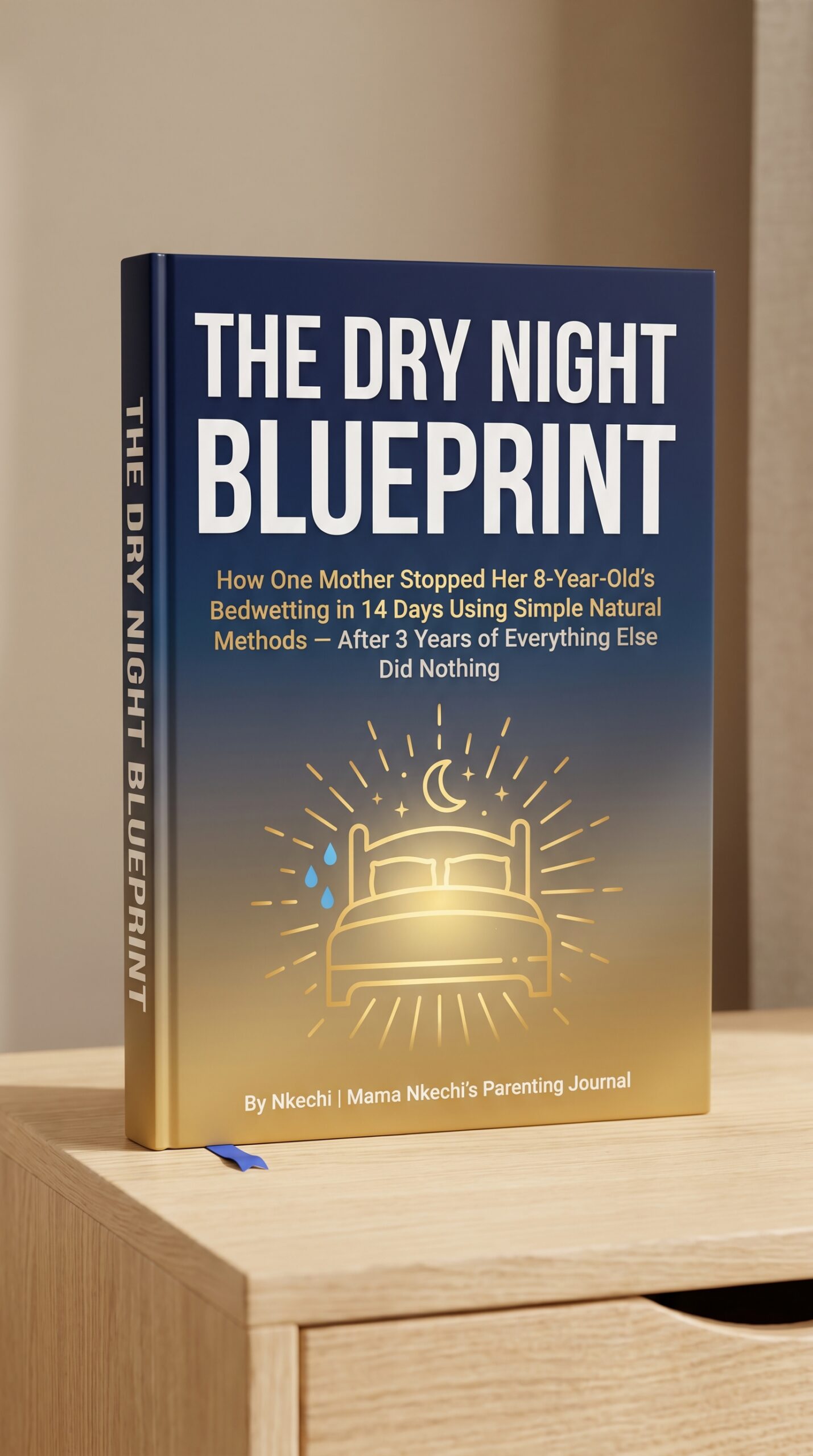
The Dry Night Blueprint
How One Mother Stopped Her 8-Year-Old's Bedwetting in 14 Days Using Simple Natural Methods — After 3 Years of Everything Else Did Nothing
This is not a medical textbook. There is no jargon. No complicated diagrams. No clinical language that makes you feel like you need a degree to understand what is happening to your child.
It is written the way I wish a kind, experienced mother had sat me down and explained everything 3 years ago — in plain language, with a clear day-by-day plan, and exercises my son actually enjoyed doing.
It works for children aged 6 to 14. It works whether your child has been wetting the bed for 6 months or 6 years. And it works regardless of where you live — because bedwetting is not a cultural issue or a parenting issue. It is a developmental one. And the solution is universal.
Inside this guide, you will discover:
- The real reason your child wets the bed — and why it has nothing to do with laziness, deep sleep, or drinking too much water before bed — Pg. 4
- Why the 3 most common approaches (limiting fluids, midnight wake-ups, bedwetting alarms) actually make bedwetting WORSE — and what to do instead — Pg. 8
- The Bladder Training Exercises — 3 simple daytime activities that strengthen your child's bladder-brain connection. They take 5 minutes and feel like a game to your child — Pg. 12
- The Evening Routine Protocol — the exact sequence of steps to follow every night that prepares your child's body for a dry night — Pg. 17
- The "Day 1 to Day 14" Action Plan — exactly what to do each day, what to look for, and how to know it is working — Pg. 21
- The Dry Night Progress Chart — a printable chart your child fills in themselves every morning (this builds confidence and ownership — it is the opposite of a shame chart) — Pg. 27
- What to say (and NEVER say) to your child about bedwetting — specific scripts that protect their self-esteem and keep them engaged in the process — Pg. 30
- 4 red flags that mean you should see a doctor (this guide is always honest about when the problem is medical, not developmental) — Pg. 34
And the best part?
Everything is completely natural. No drugs. No alarms. No fluid restriction. No midnight torture. Just a structured system that helps your child's body complete what it was already trying to do — finish developing.
This is the same method that made Brian dry in 14 days, and has now helped 150+ families around the world finally end the wet mornings.
Real Parents. Real Results. Real Dry Mornings.
Sarah C.
Louise M.
Rashida B.
Grace P.
Maria V.
Share Your Experience
Let's Talk About The Price…
Think about what you have already spent trying to fix this:
- Pediatrician or specialist visits: $80–$300 per appointment — and you've likely had several
- Bedwetting alarm devices: $50–$150 — most of which your child slept through
- Waterproof mattress covers and bedding protectors: $30–$80
- Pull-up pants and overnight supplies: $20–$40 per month, month after month
- Extra laundry — water, detergent, electricity — every single week for months or years
- The emotional cost? Priceless. And you have been paying it every single day.
The average family spends over $600 managing bedwetting before they find something that actually addresses the root cause.
This guide costs less than one pediatrician appointment. Less than a bedwetting alarm. Less than two months of pull-up pants.
I am not going to charge you $89.
The full Dry Night Blueprint — including the 14-day action plan, bladder training exercises, evening routine protocol, progress chart, and all bonuses — is yours for just…
Introductory Price — Limited Time Only
This price increases once the first 50 copies at this rate are sold.
Once you click the button above, you will be taken to a secure payment page.
✅ Pay securely with your debit card, credit card, or PayPal
✅ After payment, you get instant access to the full guide and both bonus resources
No waiting. No shipping. You will be reading it within 2 minutes.
You Also Get These 2 FREE Bonuses…
When you grab The Dry Night Blueprint today, these 2 bonus guides are included at absolutely no extra cost:


NOTE: When I shared this in a parenting group last week, 11 families grabbed it within a few hours.
Dry Night Buyers
11 members
And today alone, 5 more families have grabbed it.
The introductory price of $29.49 will not last forever.
Once the first 50 copies at this price are sold, it goes back up.
The full guide + 2 bonus guides for just $29.49 instead of $89.00
Still unsure? I understand completely. You have been disappointed before — by the alarm, by the specialist, by the advice that went nowhere. You have every right to be cautious.
Which is exactly why you are protected by a completely risk-free guarantee:
30-Day Keep-Everything Money-Back Guarantee
Download the guide today. Follow the 14-day system with your child.
If at any point within 30 days you feel it has not helped — for any reason at all — simply send me a message and you will receive a full refund.
And you keep everything. The guide. The bonuses. All of it. No questions asked. No hard feelings.
You either see your child sleeping dry — or you pay absolutely nothing. That is how confident I am in this method.
Right Now, You Have 2 Choices:
- Take action today. Get The Dry Night Blueprint. Start the 14-day system with your child tomorrow morning. And watch the wet mornings stop — the way they stopped for Brian, and for 150+ other children around the world whose parents made this same decision.
OR
- Close this page. Set your alarm for 2am. Carry your child to the bathroom in the dark. Change the sheets before anyone wakes up. Watch your child check their own bed in the morning with that look. Wonder how many more months — or years — this is going to continue.
Your child is not broken. They are not lazy. They are not choosing this. They just need the right method — and right now, you are looking at it.
Every night you wait is another wet morning your child wakes up to.
More Parents Are Sharing Their Stories…
Jennifer H.
Emma T.
Priya K.
Claire D.
The Dry Night Blueprint © 2026. Nkechi Emily Douglas. All Rights Reserved.
Disclaimer: This guide provides general parenting and wellness information based on personal experience and publicly available pediatric research. It is not a substitute for professional medical advice, diagnosis, or treatment. If your child has other symptoms alongside bedwetting — including pain during urination, excessive thirst, or daytime wetting — please consult your pediatrician. Individual results may vary.
Sarah C. from Texas
just purchased The Dry Night Blueprint
3 minutes ago